
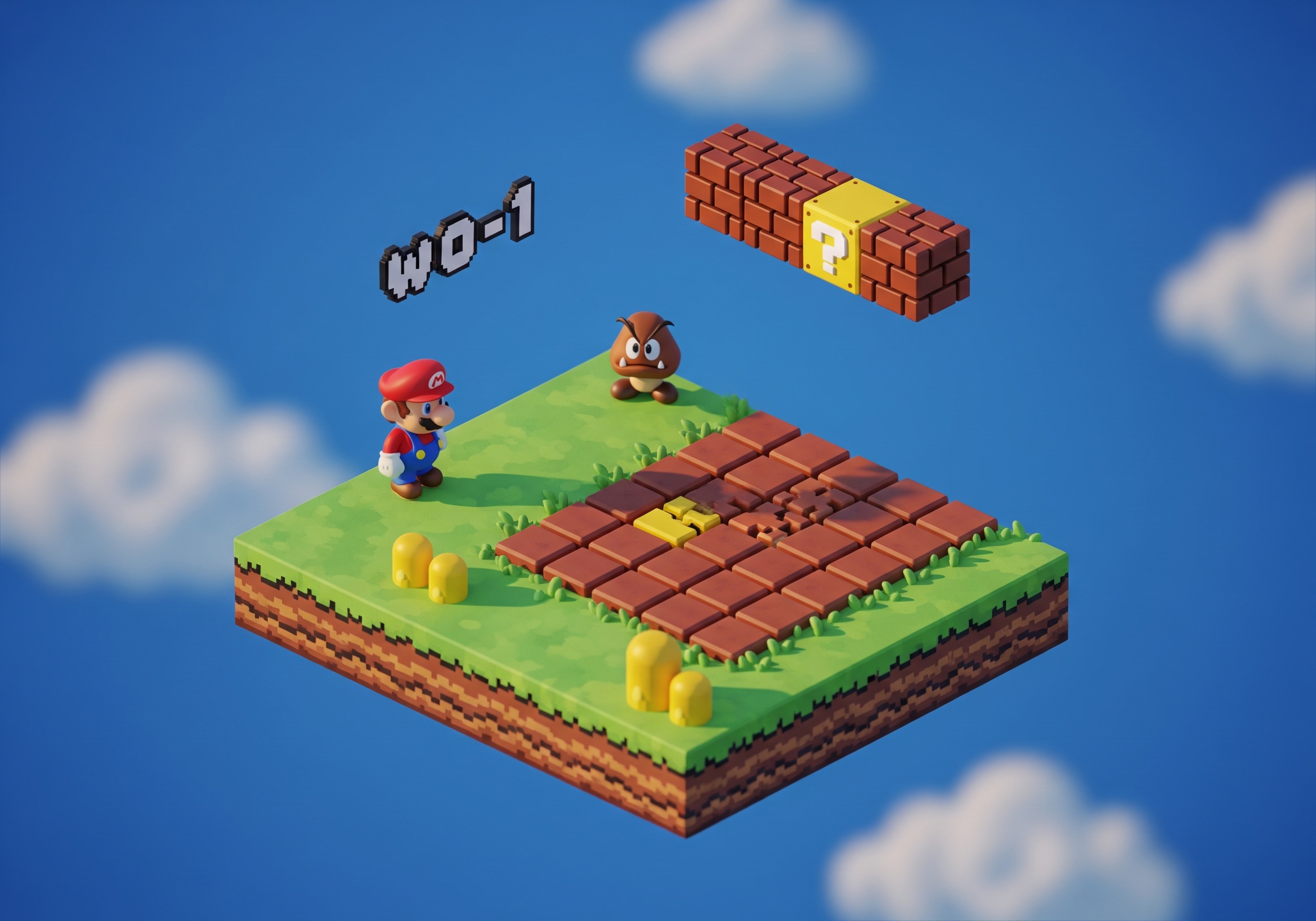
Level Design Secrets: What Makes Super Mario Bros World 1-1 Perfect
A deep dive into the genius level design of Super Mario Bros World 1-1 and why it remains the gold standard for teaching players through gameplay.
The Most Famous Level in Gaming History
When Nintendo released Super Mario Bros in 1985, they faced a unique challenge: how do you teach millions of players to control a character in a 2D platforming world without using any text or tutorials?
Their solution was World 1-1, a level so brilliantly designed that it has been studied by game designers for nearly four decades. Let's break down exactly what makes this level a masterpiece of game design.
Teaching Without Words
The First Screen
The moment World 1-1 begins, you're presented with a screen that teaches you everything you need to know:
- Mario is positioned left — The empty space to the right suggests you should move in that direction
- A Goomba approaches — You must react, teaching you that enemies are dangerous
- Question blocks float above — They invite curiosity and experimentation
- The first power-up — The mushroom emerges from a block and moves toward you
All of this happens in the first 10 seconds, completely wordlessly.
The Genius of Constraints
Notice how the designers use the environment to guide you:
- Pipes block your path — You must learn to jump
- Gaps appear — You learn to time your jumps
- Blocks create platforms — You discover vertical exploration
- Hidden blocks — Reward curious players who experiment
The Four Principles of World 1-1
1. Safe Introduction
The level begins in a relatively safe area. The first Goomba appears far enough away that you have time to react. The first pit isn't until later in the level, giving you time to master basic movement.
2. Escalating Challenge
Once you've mastered basic movement:
- More enemies appear together
- Gaps become wider
- Platforms require more precise jumps
- The famous flagpole requires timing to maximize points
3. Optional Secrets
World 1-1 contains numerous secrets for observant players:
- Hidden 1-Up mushroom blocks
- The underground coin room (via the first pipe)
- The warp zone (in later levels, teaching players to explore)
This creates a layered experience where beginners can complete the level while experts discover hidden depths.
4. Consistent Visual Language
Everything in World 1-1 follows clear rules:
- ? Blocks = Interactive, hit from below
- Brick blocks = Can be broken (as big Mario)
- Solid platforms = Safe to stand on
- Enemies = Avoid or jump on
These rules, once learned, apply throughout the entire game.
The Psychology Behind the Design
Flow State
The level is designed to induce flow state — that perfect balance between challenge and skill. The difficulty increases just fast enough to keep you engaged, but not so fast that you become frustrated.
Positive Reinforcement
Every successful action is rewarded:
- Collect a coin? Ding!
- Hit a block? Power-up appears
- Defeat an enemy? Points appear
- Reach the flagpole? Fireworks (if your timing is right)
Learning Through Failure
When you die in World 1-1, you usually understand why you died. The level teaches you that:
- Touching enemies is bad
- Falling in pits is fatal
- Time matters
This clear cause-and-effect relationship encourages you to learn and improve.
Modern Lessons from a Classic
What can today's game designers learn from World 1-1?
1. Show, Don't Tell
Instead of text tutorials, let players discover mechanics through carefully designed encounters. The first Goomba, the first power-up, the first pit — each teaches a lesson through experience.
2. Layer Your Content
Design levels that work for both beginners and experts. The main path should be accessible, while secrets and challenges reward mastery.
3. Establish Clear Rules
Create a consistent visual language so players can predict how the world works. When players understand the rules, they can focus on execution rather than confusion.
4. Reward Experimentation
Hide secrets that reward curious players. This encourages exploration and increases replay value.
Comparing to Modern Games
Many modern games have moved toward explicit tutorials with text prompts, button indicators, and guided sequences. While this approach works, something is lost when players are told what to do rather than discovering it themselves.
Games like Celeste, Hollow Knight, and Shovel Knight have taken cues from World 1-1, designing levels that teach through play rather than instruction.
Try It Yourself
The next time you play Super Mario Bros (you can try it on our platform), pay attention to how the level guides you. Notice:
- Where you naturally want to go
- What makes you curious
- How the game teaches you new mechanics
- When you feel challenged vs. comfortable
You'll discover a level of intentionality that makes World 1-1 not just fun, but genuinely brilliant.
Conclusion
World 1-1 of Super Mario Bros is more than a nostalgia trip — it's a masterclass in game design that remains relevant today. By understanding why it works, we can appreciate the artistry behind our favorite games and apply these principles to our own creative work.
The best tutorials don't feel like tutorials at all. They feel like play.
Want to explore more game design analysis? Check out our articles on why retro games feel more engaging and the psychology of difficulty in classic games.
About the Author
Innovatex Team is part of the Innovatex team, dedicated to preserving and sharing the rich history of retro gaming with enthusiasts worldwide.
Related Articles

The Psychology of Difficulty: Why Classic Games Feel Fair Even When They're Hard
Explore the psychological principles behind classic game difficulty and why retro games create satisfying challenges that feel fair rather than frustrating.

The Art of 8-Bit Sound: How Chip Tunes Created Memorable Gaming Moments
Discover how the technical limitations of 8-bit sound chips led to some of gaming's most iconic and memorable music and sound effects.